

Washington D.C. – U.S.A. October 26 – 30, 2026
This course aims to be practical. We hope that through it, you will gain a good understanding of principles for election design that you can use in your work every day — by applying those principles to materials from your own office.
For this course, we want you to practice on your own stuff. We’re pretty confident that there is a form or a web page or a notice that you’ve been unhappy with for a while. So, you’ll choose something from your own office to work on as your class project. From the very first unit, you’ll apply what you’re learning to your chosen project: a ballot, a form, a set of procedures, or some other item that you’d like to review, evaluate, and improve.
In each unit, we will tackle a different aspect of election design, from plain language to ballot design. You’ll practice your skills on a range of materials from forms to websites. And you will learn how to do usability testing in simple, effective ways. Participants will have the opportunity to discuss with experts in the field and observe the conduct of midterm elections in the United States as International Observers.
We’ve pulled together short readings or videos, along with activities and assignments to go along with each unit. We have designed this course to be very interactive. The idea is that you get to practice a good design process of trying out ideas and then reviewing them with others and through usability testing.
In addition to your personal work on the project you choose, we’re opening up discussion boards where you can share your materials and your progress — and questions and experiences with trying to improve them. We expect you to take an active part in the weekly discussions. In fact, sharing and discussing your work is part of the assignments. It’s not cheating to build on ideas from others. In the real world, few designers work completely alone!
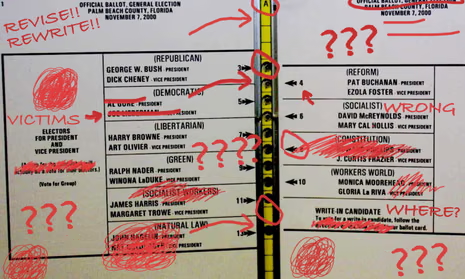
Writing with focus on Voters Understanding (Plain Language): Plain language is one of the foundations of election design. We forget how much of the language of election administration is difficult for regular people to understand. As you learn about the principles of election design that apply to plain language, you will practice editing some typical election information following those guidelines.
Plain language Practicum: As you work on a larger document for your assignment, you will also practice a design process of making incremental changes towards a complete revision. This is a core concept in the course, which will be looked at in several different units. There are three short case studies to look a little more deeply than the simple untangling of text
Checking Your Design (Usability Testing): Typically, election officials collect a ton of feedback from various sources after an election: call centers, poll workers, media reports, and social media, even talking with voters. There is a method for finding out what users find frustrating or have questions about before an election called usability testing. This is more than a review with users. It is a kind of logic and accuracy test of your materials from the point of view of the audience.
Election Forms: Participants put together some of the basic principles of election design, plain language, and usability testing. Participants will start with forms and ballots because elections are full of forms, most of which have legal consequences for voters and the outcome of elections. The most important form is the ballot, which we will look at in detail later in the course.
Accessibility (Making Things Work for Everyone): Elections have a legal obligation to be accessible under international law. But this is easier when you understand what makes it difficult for people with all kinds of disabilities to participate in elections. We’ll start by looking at what your organization already does to support voters with disabilities. We’ll identify the legal requirements for accessibility in elections and discuss the different types of disability (vision, hearing, dexterity, mobility, cognitive, literacy).
Designing Election Department Websites: People are much more likely to look for voter information on the web than in a newspaper these days. Our research showed that many people in our study had been to government websites to get answers to various questions or to get government services, but few knew that their election office had an election website. Websites make up an indispensable part of the election information ecosystem. Creating a website that answers voters’ questions will help voters be confident in themselves and trust you more as an elections official. People want to be voters. They want to be ready to vote. They want to know what will be on their ballot so that they can prepare. First-time voters need to know what voting is like. Long-time voters need to know what’s new.
Voter Information: Choosing How to Communicate with Voters and Designing Voter Education banners, flyers, and Booklets. Participants will be able to:
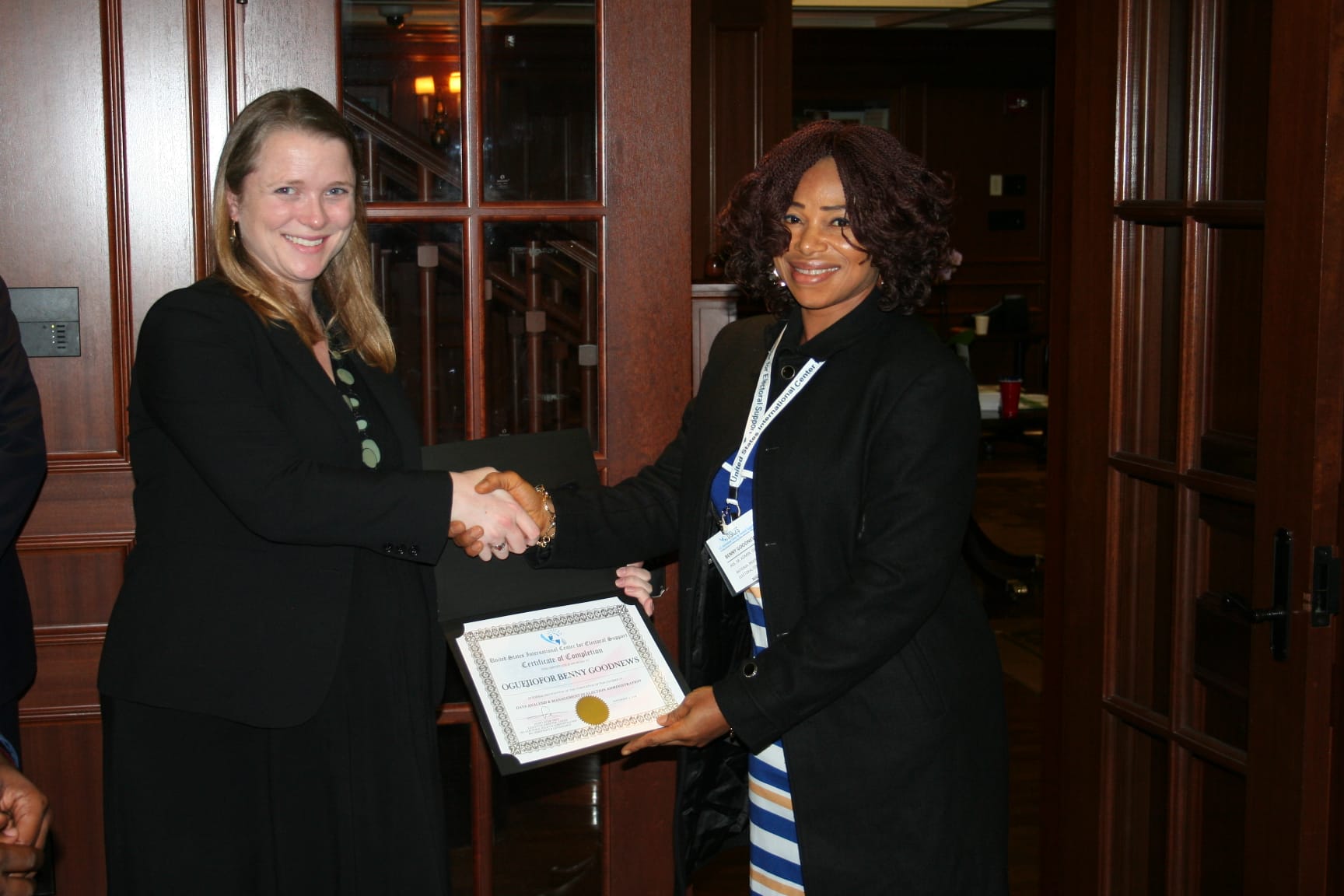
Facilitators use activity-based approaches that maximize retention of knowledge and skills learned. In addition, the training is designed to promote or reinforce professional confidence, ethics, understanding of principles of best electoral practice, and access to networks of peers. Facilitators encourage participants to reflect on their better organization, providing comparative examples and alternative approaches, generating blueprints or support for organizational reform. Participants will be evaluated for each topic through quizzes and a final test after the training to complete the course and get a certificate.
Participants will also have the opportunity to receive practical on-site scenarios and meetings with officials of United States based State and Local Election offices to have firsthand knowledge on how elections are administered in the United States. This presents an avenue to build networks and promote the exchange of experiences between participants and U.S. election officials.
This course is primarily important for:
Prospective applicants wishing to apply must submit a written application/cover letter together with their resume and two (2) references to courses@usices.org.
Course instructors will then review the applications and CV/resume. Once the instructor accepts or denies your application, you will receive notification by email. If your application is accepted, you will receive further instructions by email, including payment information. Applicants will be notified about the outcome of their application within 10 working days. Applications will be accepted on a rolling basis and will stop when the required number of participants is reached.
The cost for the training is $1200 and covers tuition, study materials, breakfast and lunch for the duration of training, ground transportation to and from selected U.S. Federal, States, and County election offices. Complete payments must be received not more than 14 days after notification of acceptance. Participants are responsible for their own lodging and travel arrangements, including visas. USICES offer reduced hotel rates through some partner hotels. Selected participants will be provided with the list of these hotels.
Please email courses@usices.org with a request for an invitation letter to join the course. Once it has been emailed to you, it should be provided to the U.S. embassy at which you apply for a visa. Please note that you will need a tourist (B or B1) visa; because our courses are not a university program, a more complicated visa process for study in the United States is not necessary. Note also that we are not able to influence the decisions of U.S. embassies, but our staff will be attentive to respond to any questions the embassy may have about your application. Invitation letters are sent to applicants who have completed the application process and paid the course fee.